Your website might look good, load reasonably quickly, and explain your services clearly, yet still struggle to attract visitors from Google. Alternatively, you might receive plenty of search traffic without seeing the enquiries, bookings, or sales you expected.
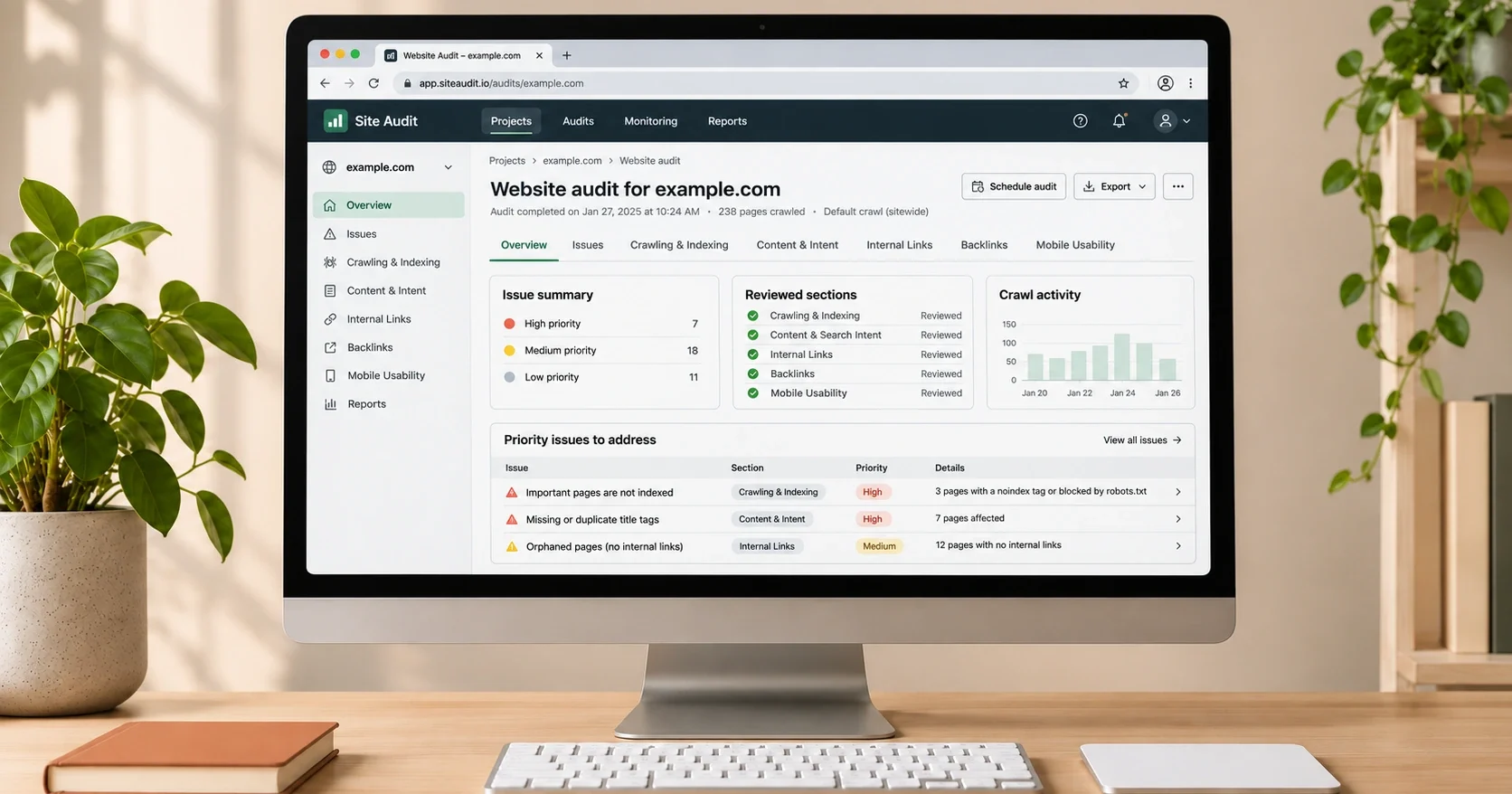
An SEO audit can help establish what’s happening. But a useful audit should do more than produce a long report of errors. It should explain which problems matter, what evidence supports the findings, and where improvements are most likely to be worthwhile.
Quick answer
An SEO audit is a structured review of a website’s search visibility, technical condition, content, backlinks, and other factors that influence how people find and use it.
It usually examines crawling and indexing, important pages, search intent, internal and external links, website performance, competitors, and search data. Local businesses and online stores may need additional checks specific to how they attract customers.
The result should be a prioritised set of findings and recommendations. An audit identifies what needs attention, but it does not automatically include implementing every improvement or guarantee higher rankings.
What is an SEO audit?
An SEO audit examines whether search engines can access your website, whether its pages meet relevant search needs, and whether technical, content, or other issues are limiting performance. The review should start with the website’s purpose, because a local electrician, an appointment-based business, and an online retailer have different priorities.
For a service business, the question may be whether customers can find the right service page and make an enquiry. For an online store, it might be whether collections are indexed correctly, products are easy to reach, and technical problems affect large groups of pages.
We work with service websites and ecommerce stores, alongside running our own businesses in both areas. That experience reinforces why an audit needs to consider customer journeys as well as technical results. An enquiry form that fails on mobile or important products that are difficult to find can matter more than a minor automated warning.
What does an SEO audit include?
The checks depend on the website, its size, and the problems being investigated. A focused review may examine one indexing issue, while a comprehensive audit can cover technical SEO, content, backlinks, competitors, and search performance.
Crawling and indexing
Search engines need to discover, access, and process your pages before considering them for search results. An audit reviews whether important pages can be crawled and indexed, looking at robots.txt rules, noindex directives, canonical URLs, redirects, errors, XML sitemaps, and internal links.
Google Search Console can identify pages Google knows about but has not indexed. That does not mean every excluded URL needs fixing. Duplicates and internal search results may be excluded deliberately, as Google’s Page indexing documentation explains. The priority is making sure useful, commercially important pages can appear in search.
Website structure and internal links
Navigation helps visitors reach the information they need, while internal links help search engines discover pages and understand their relationships. An audit checks whether important services, products, and supporting guides are logically connected.
An ecommerce store may have useful products buried beneath difficult-to-navigate collections. A service business may have several relevant articles that never link to the main service page. Improving those routes can be more worthwhile than publishing additional content.
Content and search intent
Search intent describes what someone wants to achieve. A search for “SEO services Manchester” calls for a different page from “What does an SEO audit include?” One needs clear service information and an enquiry route; the other needs an explanation that answers the question.
An audit assesses whether pages are accurate, useful, complete, and organised for their intended searches. It may identify overlapping pages without distinct value, missing information, or content that needs updating. Page titles, headings, descriptions, image alt text, and structured data should also describe the content accurately. Improving an existing page is often preferable to creating another one without a clear purpose.
Backlinks and off-page SEO
Backlinks are links from other websites to yours. An off-page review considers which websites link to you, which pages attract useful references, whether important links have been lost, and whether suspicious patterns warrant investigation.
For example, a relevant website may still link to a service page removed during a redesign. An audit can check whether that address needs an appropriate redirect. Backlink quantity alone does not establish quality, and unfamiliar links do not automatically need removing. The aim is to identify genuine problems and worthwhile opportunities.
Competitor analysis and search opportunities
An audit may compare your pages with the businesses, directories, and specialist publications that appear for relevant searches. Those search competitors are not always the same as your direct commercial competitors.
The review can examine missing subjects, differences in search intent, content quality, site structure, and useful external references. If competitors explain their services, prices, and suitability more clearly, improving your existing pages may be more effective than copying their keywords or adding another general article.
Website speed and mobile usability
Performance checks examine whether pages load reliably, respond to interactions, and remain visually stable. Google’s Core Web Vitals guidance explains Largest Contentful Paint (LCP), Interaction to Next Paint (INP), and Cumulative Layout Shift (CLS). PageSpeed Insights and Search Console can help investigate issues, although laboratory tests and real-user data measure different conditions.
Large images, unnecessary scripts, unstable layouts, confusing navigation, and broken enquiry forms can all affect visitors. A high speed score does not make a website useful on its own, so an audit should distinguish genuine usability problems from minor warnings.
Local search and ecommerce requirements
Local businesses may need their service areas, contact details, Google Business Profile, and local search visibility checked. Inconsistent information can make it harder for customers to understand where a business operates.
Ecommerce reviews may examine collections, products, variants, filters, stock availability, structured data, and navigation. A store might generate multiple filtered URLs that offer little independent value while making important products harder to find. Our guide to what ecommerce SEO includes explains these requirements in more detail.
Search performance and measurement
Search Console data can show which queries and pages receive impressions and clicks. Website analytics may then help establish whether visitors make enquiries, book appointments, or buy products. An audit should compare performance over time and distinguish a problem affecting one page from a site-wide change.
Not all outcomes are tracked perfectly. A telephone enquiry may not be attributed to the original search visit, for example. Findings should acknowledge gaps in the evidence rather than treating incomplete figures as proof of success or failure.
How should SEO audit findings be prioritised?
An audit may identify dozens of issues, but they rarely deserve equal attention. Each finding should explain the problem, identify the affected pages, and recommend an appropriate action. The table compares five hypothetical examples covering indexing, website structure, enquiries, backlinks, and metadata.
| Finding | Why it matters | Possible next step |
|---|---|---|
| Important service page unintentionally marked noindex | The page may be prevented from appearing in search results | Confirm the intended indexing status and correct the directive |
| Important product collection difficult to reach | Visitors and crawlers may struggle to find relevant products | Improve navigation and internal links |
| Service page receiving visits but few enquiries | Visitors may lack important information or a clear next step | Review content, trust information, and the enquiry journey |
| Useful backlink pointing to a removed page | Visitors following the link may reach an error, and a relevant reference may be lost | Check the destination and consider an appropriate redirect |
| Minor metadata inconsistency on a low-priority page | It may have limited immediate commercial impact | Correct during routine content maintenance |
These are examples, not universal rankings. A critical indexing error may deserve attention before new content is written, while an indexed website could have more pressing problems with its service descriptions or enquiry journey.
Priorities should also reflect how many pages are affected, the evidence available, and the work involved. Correcting one page can be straightforward; addressing a problem across thousands of ecommerce URLs may require development, testing, and a separate project. The strongest recommendations reflect business needs rather than how technical an issue sounds.
What should you receive after an SEO audit?
An SEO audit report should explain what was reviewed, what was found, and what deserves attention. Useful findings identify affected pages or systems, explain their importance, and provide supporting evidence such as Search Console data, crawl information, or examples from the website.
Recommendations should distinguish urgent issues from routine improvements, and content changes from work needing development or specialist support. We aim to make the reasoning clear so you can understand the priorities whether you ask us to implement them or use another provider.
The level of detail depends on the review agreed in advance. Investigating one problem does not require the same reporting as examining a large ecommerce website. Diagnosis, implementation, testing, and ongoing work can also be separate activities. Our guide to what monthly SEO includes explains how continuing improvements differ from one-off reviews.
When should a business arrange an SEO audit?
There is no single timetable for every website. An audit can be useful before a significant redesign or platform migration, after an unexplained decline in relevant search traffic, or when a business wants to invest in SEO but cannot identify which problems are holding it back. For moves involving changed URLs, our website migration SEO checklist explains the checks to plan before launch and carry out afterwards. It may also help when content, navigation, or product collections have grown without a coordinated review.
Not every traffic decline means something is wrong with SEO. Seasonal demand, stock availability, and changing customer behaviour may explain some fluctuations. An established website also does not necessarily need a full audit each month; routine monitoring and targeted checks may be more appropriate between wider reviews.
Can you carry out an SEO audit yourself?
Yes. A business owner can carry out a useful initial review, particularly on a smaller website. Search Console can help check important pages and search queries, PageSpeed Insights can highlight performance issues, and analytics may show which pages support enquiries, bookings, or sales.
Review the website as a customer would, too. Can people find your services or products, understand the information, and complete important actions on a phone? These checks often reveal issues that automated reports miss.
The harder part is interpretation. Automated tools can flag redirects, metadata, or technical warnings, but they cannot reliably decide which work deserves your budget. A professional review becomes more useful when the website is complex, changes involve risk, or several problems may be affecting performance.
Should an SEO audit include AI search?
AI search is worth considering alongside existing SEO checks. Google’s guidance on AI features in Search confirms that established SEO practices apply to AI Overviews and AI Mode. Pages must meet the normal requirements for indexing and search snippets; no separate technique guarantees inclusion in an AI-generated answer.
An audit may check whether important information is accessible, clear, internally linked, and supported by credible evidence. It may also review relevant AI crawler access and Google’s Search generative AI control, which can exclude content from supported AI search features while leaving ordinary search eligibility intact.
Measurement depends on the platform. Google’s Generative AI performance report provides impression data for supported features where sufficient information is available. Microsoft’s AI Performance report in Bing Webmaster Tools covers citations across supported Microsoft experiences. Neither a citation nor an impression is the same as a visit or customer enquiry.
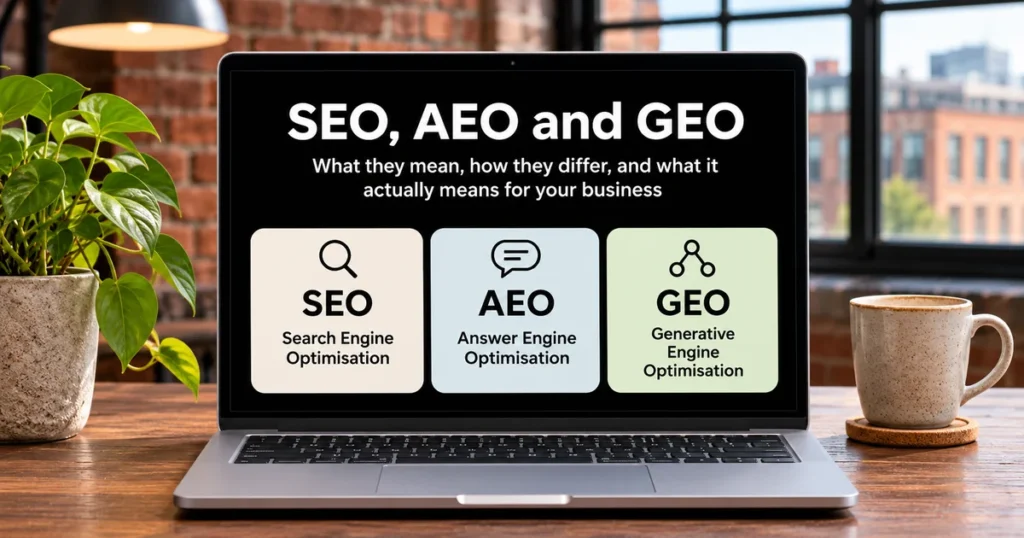
Our guide to SEO, AEO, and GEO explains where the approaches overlap and when additional work may be worthwhile.
What is the difference between an SEO audit and ongoing SEO?
An audit assesses the current position and recommends priorities. Ongoing SEO involves completing agreed improvements, measuring their effects, and deciding what to work on next. Recommendations alone do not improve a website until someone implements them.
An audit might identify service pages that need rewriting or problems with an ecommerce collection structure. The resulting work could involve content editing, development, testing, and monitoring over several weeks or months. Some businesses need only a focused correction, while others benefit from regular improvements as their websites and markets change.
An audit does not automatically mean committing to ongoing SEO. The decision should depend on the work needed and the business’s priorities. Our guide to how long SEO takes to work explains why results can emerge on different timescales.
Common questions about SEO audits
What access does an SEO auditor need?
Many initial checks can be completed using publicly available pages. Access to Google Search Console or website analytics can help verify findings, while some technical investigations may require WordPress or hosting access. Agree what is needed first, give only the permissions required, and avoid sharing account passwords.
How long does an SEO audit take?
A focused review of a small website may take a few working days, while a comprehensive audit of a large or technically complex website can take considerably longer. The timing depends on the number of pages, the issues being investigated, the available data, and the reporting required. The work involved and expected completion date should be agreed before work begins.
How much does an SEO audit cost?
The cost depends on the depth of the review, the website’s size, and whether technical investigation, competitor research, reporting, or implementation planning is required. A focused review and a comprehensive ecommerce audit are different projects. Check what is included before comparing quotations. Our guide to SEO costs in the UK explains the wider pricing considerations.
Can an SEO audit disrupt my live website?
Most audits involve reviewing information and running checks rather than changing the live website. Larger crawls or active tests may need extra care on a busy or resource-limited site. Any changes to settings, content, or code should be agreed separately and tested before implementation.
What if my website has little or no search data?
An audit can still assess crawling, indexing, content, navigation, and usability, even for a new website. Limited data makes it harder to judge search trends or estimate opportunities, so the report should explain that uncertainty and recommend suitable measurement before drawing conclusions.
SEO audits and website reviews
Get clear priorities for your website
We can review your website, investigate the issues affecting search visibility, and explain which improvements deserve attention. You will receive clear recommendations based on your website and business priorities, whether you need a focused SEO audit or wider digital consultancy.
Sources and further guidance
Google Search Central’s SEO Starter Guide covers website structure, content, and search visibility. Google’s documentation also explains page indexing, Core Web Vitals, and AI features in Search. Further Google and Microsoft references appear alongside the relevant explanations above.