
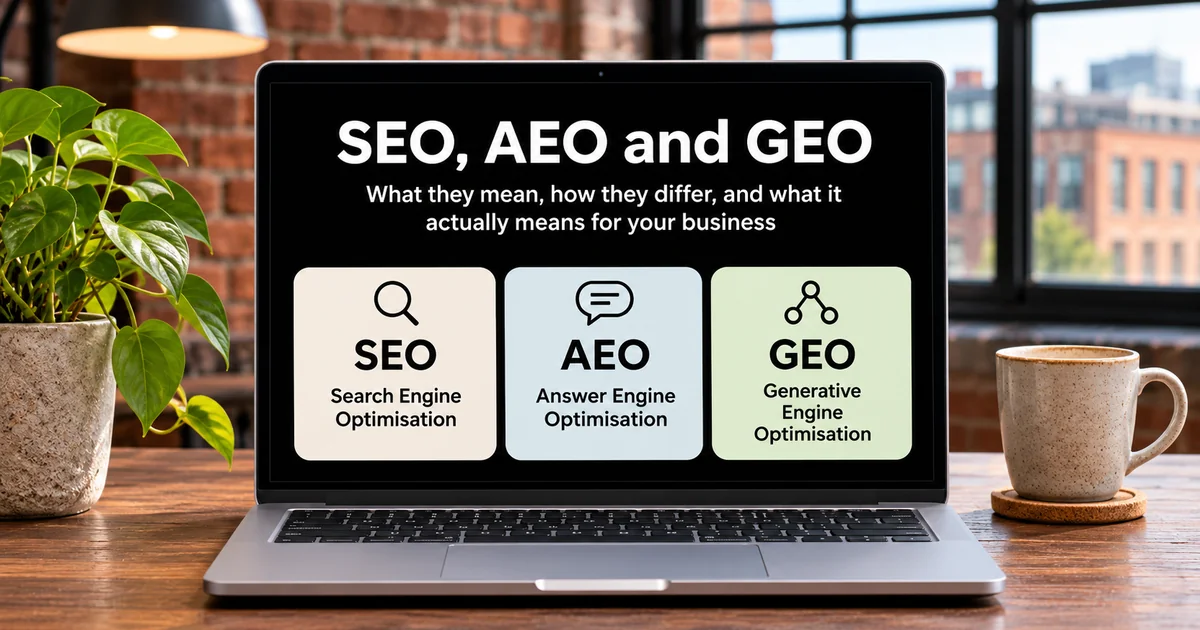
SEO, AEO, and GEO are appearing more often in conversations about search marketing. If you run a business, you may be wondering whether SEO is being replaced, whether your website needs changing for AI search, or whether you now need three separate services.
You do not need three unrelated strategies. These terms describe different aspects of how people find information, but much of the underlying work is the same. The important question is how your business can remain useful and visible when someone searches, asks a question, or uses an AI assistant to research a purchase.
Quick answer
SEO means search engine optimisation. It helps search engines find, understand, and show relevant pages from your website.
AEO means answer engine optimisation, usually referring to making information useful for direct answers.
GEO means generative engine optimisation, which focuses on how a business or its content appears in AI-generated responses.
AEO and GEO do not have universally agreed definitions and often overlap. Most businesses need one search strategy that covers traditional results and AI-powered answers, with separate measurement where useful.
What do SEO, AEO, and GEO mean?
SEO: search engine optimisation
SEO is the work involved in improving a website’s visibility in unpaid search results. It includes understanding what people search for, creating pages that meet those needs, making important content accessible to search engines, and helping visitors use the website once they arrive.
For a Manchester service business, that could mean improving its service pages, making prices and service areas clear, keeping its business information accurate, and ensuring that someone searching for its services can find the right page. For an online store, the emphasis might be on collections, product information, internal links, and technical issues affecting a large catalogue.
SEO is broader than getting a page to rank for a keyword. Good search visibility is only useful if visitors find accurate information and can take the next step, whether that means making an enquiry, booking, or buying.
AEO: answer engine optimisation
AEO generally refers to improving the chances that a website’s information can be used to answer a question directly. Depending on who is using the term, that may include featured snippets in traditional search, voice-assisted answers, Google’s AI features, or responses from AI assistants.
Suppose someone asks, “How long does it take to build a business website?” A helpful page should answer that question directly and then explain the factors that affect the timescale. Clear answers are useful to visitors, whether the answer appears on the page itself, in a search result, or as part of an AI-generated response.
That does not mean turning every paragraph into a question and answer or filling pages with repeated definitions. Clear headings, accurate details, and complete explanations are valuable because they serve the reader.
GEO: generative engine optimisation
GEO generally refers to improving how a brand, business, or source appears in answers generated by AI systems. Those answers can bring together information from several websites, cite particular pages, or mention a business without sending the user to its website.
For example, someone might ask an AI search tool to compare two ecommerce platforms or suggest what to look for when choosing a web designer. A useful source might be cited because it gives a well-supported explanation. A business may also be mentioned because information about its services is consistent and available across relevant sources.
There is no agreed industry boundary between AEO and GEO. Some marketers use AEO as the broader term and GEO as one part of it. Others draw the distinction the other way around. The labels can be useful for discussing visibility, but they should not determine the work a business pays for.
What is the difference between SEO, AEO, and GEO?
All three terms concern whether people can find and understand useful information about your business. The table below compares their usual emphasis. The categories are descriptions of overlapping activities, not separate technical standards.
| Term | Typical focus | What you might measure |
|---|---|---|
| SEO | Visibility in organic search results and the usefulness of the pages people reach | Relevant clicks, impressions, enquiries, sales, and indexing health |
| AEO | Information that answers questions clearly in search and answer experiences | Visibility for question-led searches, appearances in answer features, and resulting visits where measurable |
| GEO | How pages and businesses appear in AI-generated responses, mentions, and citations | AI-feature impressions, supported citation reports, referrals, and business outcomes |
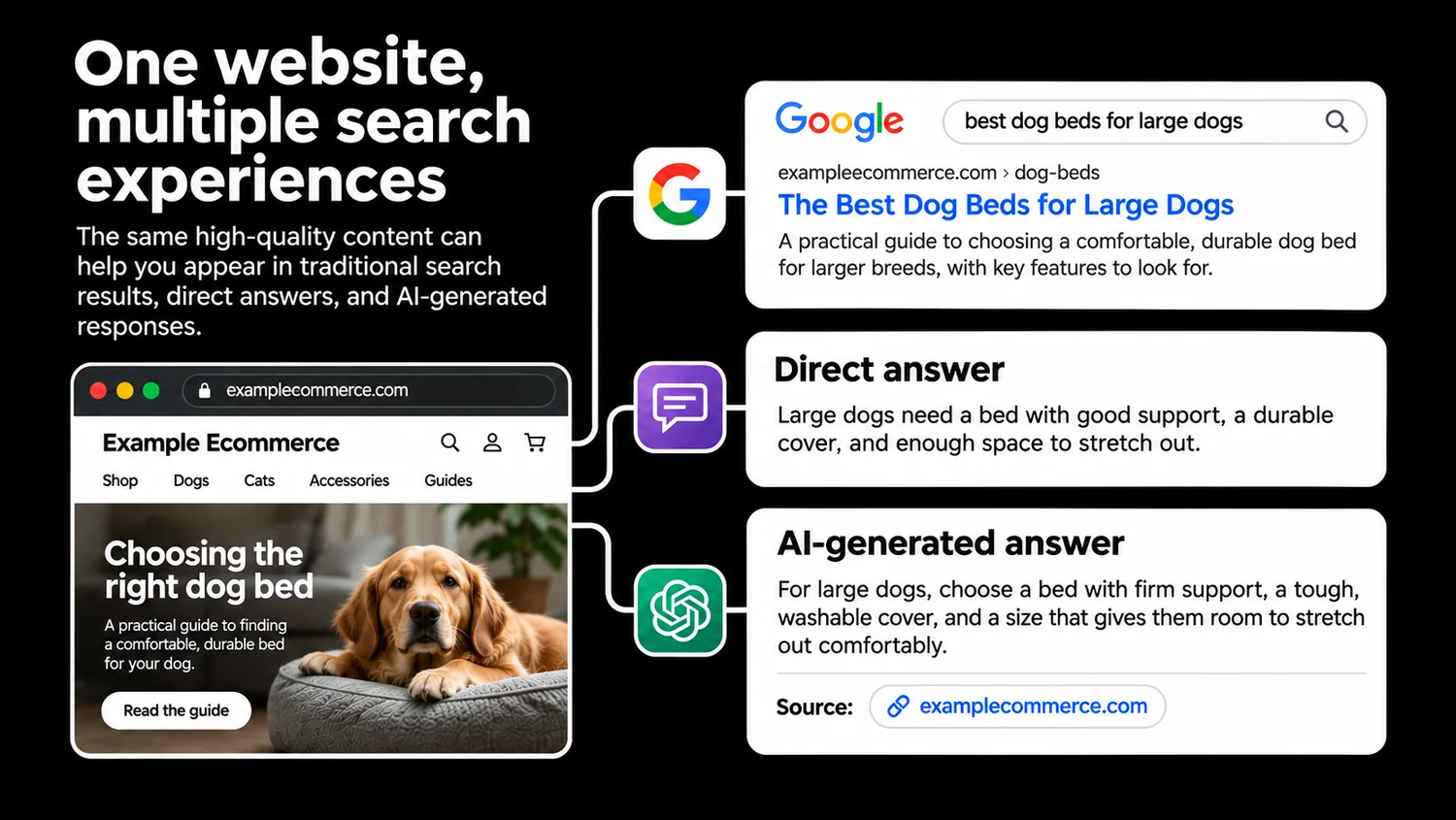
Imagine a pet retailer publishes a page explaining how to choose the right size dog bed. That page could appear in organic results for a sizing query, provide measurements for a direct answer, and be cited in an AI-generated product comparison. These outcomes are not guaranteed, and they should be measured differently. But the useful information can come from the same page without creating three near-identical versions.
Does your business need separate SEO, AEO, and GEO services?
No. For most small and medium-sized businesses, three disconnected services would introduce unnecessary duplication. One review of a website can identify issues affecting traditional search and AI-powered results together. Missing service information, inaccessible pages, vague descriptions, or inconsistent business details can affect more than one search experience. This is why we consider AI search visibility alongside our SEO service, rather than treating every new term as a separate package.
That does not mean AI search should be ignored. A business with strong existing SEO may reasonably want additional work to understand how its expertise, services, and brand appear in AI answers. A larger organisation may also need dedicated reporting across different search products. What matters is the additional work being performed and whether it addresses an identifiable business need.
If an agency offers an AEO or GEO package, ask what it adds to the SEO work already being done. The proposal should name the pages being reviewed, the technical or editorial changes involved, the platforms being monitored, and the limitations of the reporting. Our guide to what monthly SEO includes can help you check whether the proposed activities are already covered. A new acronym on an invoice is not evidence of a new service.
Is traditional SEO becoming less important?
No. Google’s own guidance explains that its generative AI search features still rely on established search and quality systems. For a page to be eligible as a supporting link in Google AI Overviews or AI Mode, it must be indexed and eligible for a search snippet. Google’s guidance for generative AI search continues to emphasise useful content and sound technical SEO.
Different AI products use information in different ways, so a strong Google ranking does not guarantee a mention in every AI answer. Nor does an AI citation guarantee a visit. Traditional organic search, AI-generated answers, and enquiries remain related but distinct things to measure.
What should businesses actually do about AI search?
The starting point is to check whether your existing website answers the questions customers need answered. Search engines and AI systems cannot reliably represent information that a business has not published clearly in the first place.
Make important business information easy to find
Your main service or product pages should explain what you offer, who it is for, where it is available, and what someone needs to know before making a decision. Important information should not be buried in an image or hidden behind an interaction that prevents search engines from accessing it.
For a local business, consistent contact information, operating details, service areas, and an accurate business profile can also matter. For an ecommerce store, product details, prices, variants, availability, and delivery information need to reflect what the business can actually supply. Our guide to ecommerce SEO covers these priorities for product and collection pages in more detail.
Give straightforward answers, with enough explanation
People often search in questions, particularly when comparing services or working out which option they need. Answer those questions directly within the relevant page, then explain any conditions or exceptions. A clear answer about cost, suitability, timing, or limitations is more useful than a long introduction that avoids the question.
FAQs are worthwhile when they cover genuine follow-up questions. They should not replace the main explanation or repeat whole sections merely to target different versions of a keyword.
The illustration below shows how one useful product guide can support several search experiences. These placements are examples rather than guaranteed results.
Publish information that comes from real experience
Generic explanations are easy to reproduce. First-hand examples, accurate pricing, clear process details, original comparisons, and evidence from work you have actually done provide something more useful to readers. Our Charlie Scott’s ecommerce and SEO case study includes a dated search performance snapshot and explains what the figures do and do not demonstrate. The value comes from evidence, not from claiming content was written for AI.
Relevant external coverage and consistent information about your business may also help people verify what you say. This does not justify buying artificial mentions, adding unsupported statistics, or producing large numbers of near-identical pages.
Keep the technical foundations in place
Search crawlers need to reach your important public pages. Check indexing settings, robots.txt rules, canonical URLs, internal links, mobile usability, and whether essential content is available in readable HTML. Where AI search crawlers are relevant, check that hosting and security rules are not unintentionally blocking legitimate access. Our guide to SEO audit checks and priorities explains how these issues are assessed alongside content and search performance.
Google also provides a Search generative AI control in Search Console. This is separate from ordinary search indexing. If a site has opted out, its links and content are excluded from Google’s supported generative AI search features, even though its ordinary search listings may remain eligible. Check this setting before assuming that a missing AI appearance is a technical SEO problem.
Structured data can help eligible search features understand particular information, but it should match what visitors can actually see. Google does not require special AEO or GEO schema, a separate AI text file, or a particular rewriting technique to qualify for its AI search features. Fix technical problems that exist rather than installing something simply because it is being marketed as an AI SEO requirement.
Improve existing pages before producing more
Review your most commercially important pages first. If the service page someone needs is incomplete, another general blog post may not solve the problem. If a guide already answers a question well, it may need a factual update or a better internal link rather than a new article covering the same subject.
Businesses with established search traffic should also avoid changing every successful page at once. A measured review makes it easier to tell whether an adjustment helped visitors or simply changed the way information was presented. Our guide to how long SEO takes to work explains why results can emerge over different timescales.
How can you measure SEO, AEO, and GEO results?
AI search measurement has improved during 2026, but a citation, a search impression, and a customer enquiry are not interchangeable. Separate reporting can help show where a business is visible, provided the figures are interpreted correctly.
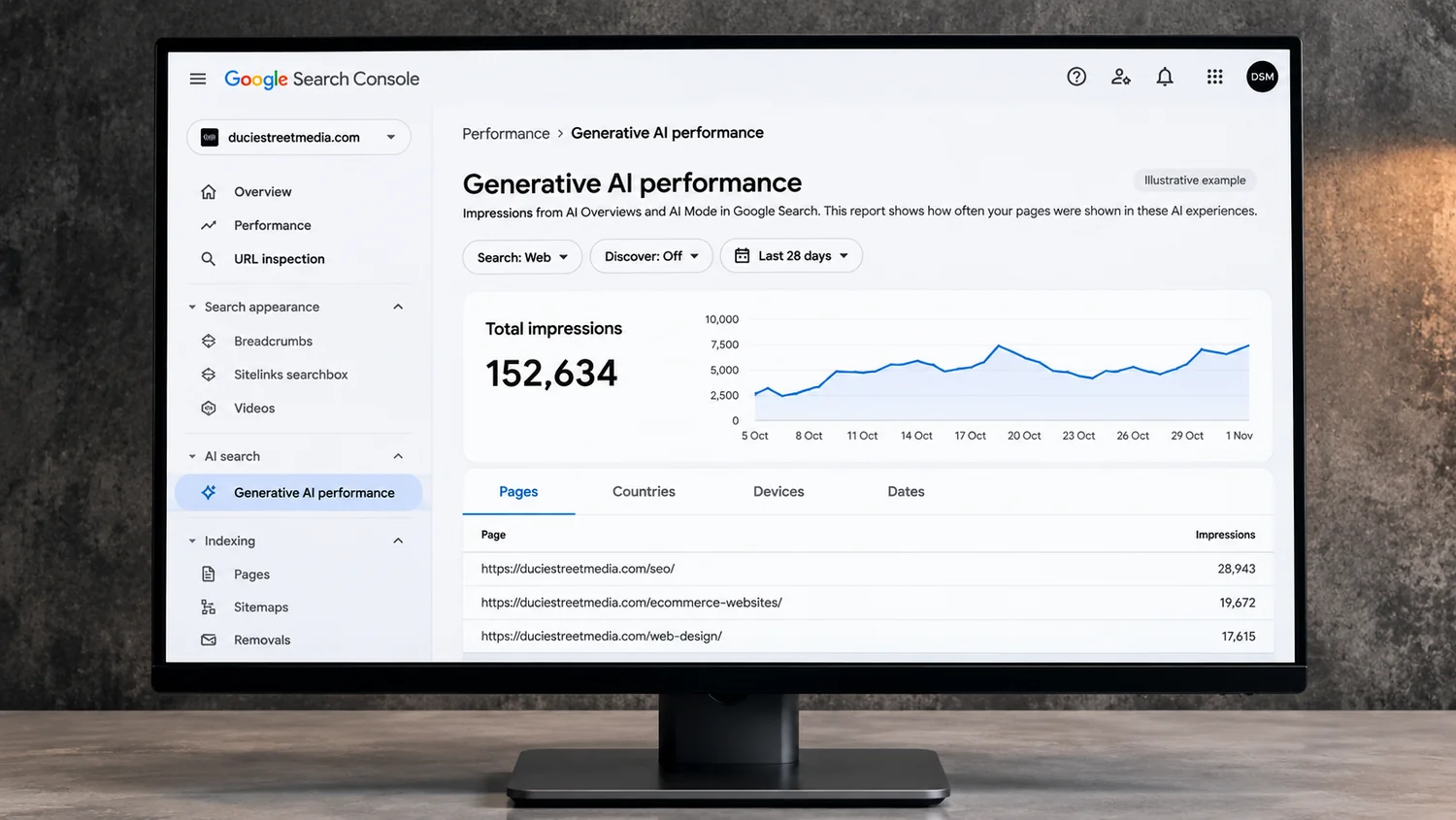
Google Search Console
Google’s generative AI performance report became available worldwide on 31 August 2026. It reports impressions for eligible links shown in Google AI Overviews and AI Mode, including breakdowns such as pages, countries, devices, and dates. A website with insufficient activity may not see the report.
That is useful visibility information, but an impression does not mean someone clicked, made an enquiry, or became a customer. Continue reviewing the site’s overall search performance alongside the dedicated AI report rather than treating the new figures as a replacement.
Bing Webmaster Tools
Microsoft’s AI Performance report shows citation activity across supported experiences including Copilot and AI-generated Bing summaries. It can indicate which pages have been cited, show grouped grounding queries, and help you review changes over time. Microsoft has also added preview reporting for topics, intent, and citation share, as well as a Topics Portfolio beta introduced in October 2026.
These figures do not establish how a page ranked, how prominent a mention was, or how much revenue it generated. They are also aggregated rather than a complete record of every answer.
Website visits and genuine business outcomes
Use website analytics to review traffic from identifiable referral sources where that data is available. More importantly, check whether relevant visitors are making enquiries, placing orders, or completing other meaningful actions. Referral information may be incomplete, and some people will contact a business later or through another channel.
For most small businesses, the sensible reporting approach combines ordinary organic search performance, available AI visibility data, and real business results. A report built entirely around the number of times a brand appeared in an AI answer can give a misleading picture of success.
What should you prioritise now?
Start with the website you have. Check that your important pages can be found, explain your services or products clearly, and give customers the information they need to decide. Use AI search reporting where it provides useful evidence, but judge progress against relevant visits, enquiries, sales, and other business outcomes.
Before paying for additional SEO, AEO, or GEO services, establish which improvements are already covered, what genuinely needs attention, and how the work will be measured. The priority is a clearer, more useful website, not a separate package for every search term.
Common questions about SEO, AEO, and GEO
What should I do if an AI answer gives incorrect information about my business?
Check your website, business profiles, and any sources cited in the answer. Correct outdated information you control, and use the AI service’s feedback options where available. An update may not appear immediately, and you cannot force a particular answer to change.
Can my service page appear in AI answers without a blog article?
Yes. A useful service page can be cited or referenced directly. You do not need a separate article for every service or customer question. Put essential information on the page where customers expect to find it, and publish extra guidance only when it answers a genuine additional question.
Why does my business appear in one AI search tool but not another?
Different services may use different sources, retrieval methods, and ways of generating answers. Results can also change with the wording of a question and over time. One mention does not establish consistent visibility, so compare a representative set of relevant questions rather than relying on a single test.
How often should I review AI search reporting?
A monthly review is a reasonable starting point when enough information is available. Review trends alongside ordinary search performance and enquiries. Check important pages sooner after significant website changes or when you find that an AI answer contains incorrect business information.
Is it useful to compare my AI search visibility with competitors?
It can help identify relevant questions where competing businesses are mentioned or cited. Use the same questions and review conditions where possible, and check the sources behind the answers. A mention is not evidence of enquiries or sales, and occasional checks cannot provide a complete ranking of businesses.
SEO and AI search support
Know which SEO work your website actually needs
We can review your current website, identify content and technical issues that matter, and explain which improvements are worth prioritising. You’ll have a clear proposal for the work involved, without paying for overlapping services.
Sources and further guidance
Google Search Central’s AI search guidance explains how established search requirements apply to AI Overviews and AI Mode. Google’s documentation also covers generative AI performance reporting and AI search controls.
Microsoft’s documentation on Bing AI visibility reporting and the Topics Portfolio beta explains the available citation and reporting information.


